
Ethiopia and Eritrea Trade Accusations as Tigray Fighting Escalates
Ethiopia has accused Eritrea of sending troops into Tigray, while Asmara says Addis Ababa is preparing an offensive as renewed fighting threatens the 2022 peace agreement.

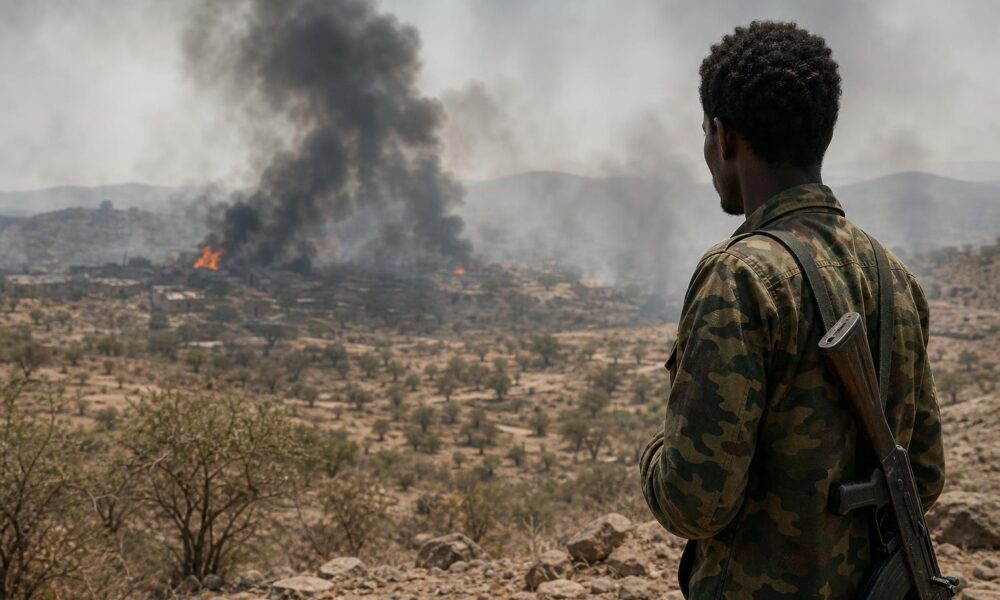
Relations between Ethiopia and Eritrea have entered a more dangerous phase after renewed fighting in Tigray and a sharp exchange of accusations between the two governments.
Table Of Content
Ethiopia says Eritrean forces advanced as far as 60km into Tigray and violated its sovereignty. In a letter to the United Nations Security Council, Ethiopian Foreign Minister Gedion Timothewos described the alleged movement as “a blatant act of aggression that engages Ethiopia’s inherent right to self-defence”.
Eritrea has rejected the allegation. In its own letter to the Security Council, Foreign Minister Osman Saleh called Ethiopia’s accusation a pretext for an offensive and described Addis Ababa’s alleged position as a “deplorable declaration of war”. He warned that an Ethiopian attack could cause “huge devastation to the peoples of both countries and destabilise the whole region”.
Battlefield advances in Tigray
Fighting escalated on September 23 after a rebel alliance including the Tigray People’s Liberation Front attacked Ethiopian government forces across Tigray, Amhara and Afar regions.
The rebels captured Mekelle and its airport before announcing their withdrawal on October 3. Government-allied forces subsequently entered the Tigray capital. Government and allied troops were also reported to have taken Idaga Hamus and Abiy-Adi.
Ethiopian government troops and allied militias reportedly entered Adigrat, a city about 30km from the Eritrean border. Footage reviewed in reports showed government-allied militia members and Ethiopian military vehicles in the city. These battlefield accounts were attributed to residents, media reports, Reuters and the Associated Press.
Other claims about the fighting remain unconfirmed. Ermiyas Ababu, commander of the government-allied Tigray Peace Force, said personnel had reported Eritrean personnel in Adigrat and Idaga Hamus, but the reports could not be independently verified. It also remains unclear who controlled Idaga Hamus and Abiy-Adi before the reported government advance, or whether Eritrean troops took part in the fighting there.
The Armed Conflict Location and Event Data Project reported that Eritrean forces crossed into Ethiopia near Zalambessa and came under an Ethiopian drone attack while moving towards Idaga Hamus. Eritrea had not commented on that account.
Risk of a wider war
The renewed violence threatens to undermine the November 2022 Pretoria agreement, which ended major hostilities in the Tigray war. Eritrea was not a party to that agreement.
Hossamaldeen Ibrahim of the Bloomsbury Intelligence and Security Institute said the confrontation had moved beyond a purely diplomatic dispute. He described it as “a high-risk phase of limited but direct military confrontation with a real possibility of rapid escalation into interstate war”.
“The danger lies in the fact that each side now treats the other’s narrative as existential,” Ibrahim said, while noting that both governments’ accounts contained elements requiring verification.
Professor Matthias Rompel of the Institute of Sociology at Justus-Liebig-University Giessen also said the danger of a wider interstate conflict was real. He cautioned, however, that a broader war was not inevitable and that the opportunity for diplomatic de-escalation was narrowing.
Tom Gardner, a correspondent for The Economist, described the current tensions as the region’s most dangerous moment since the Ethiopia-Eritrea border war of 1998 to 2000.
Red Sea access at the centre of tensions
Ethiopia, which is landlocked, has repeatedly argued that direct access to the Red Sea is essential. Prime Minister Abiy Ahmed has reiterated that position, while Eritrea is reported to fear that Ethiopia intends to seize its port of Assab.
The two countries fought a deadly border war from 1998 to 2000. Eritrea became independent from Ethiopia in 1993, and relations improved after Abiy came to power in 2018 before deteriorating again in recent years.
Eritrea fought alongside Ethiopian federal forces against the TPLF during the 2020-2022 Tigray war, a conflict associated with allegations of massacres, sexual violence and widespread hunger. Hundreds of thousands of people were reported killed.
Rompel said Ethiopia’s interest in Red Sea access, Eritrea’s concerns over sovereignty and Egypt’s strategic rivalry with Ethiopia over the Nile were interconnected. Whether either government intends to launch a full-scale war remains unclear, but analysts say the combination of military movements, political accusations and unresolved regional disputes has significantly increased the risk of escalation.





No Comment! Be the first one.