
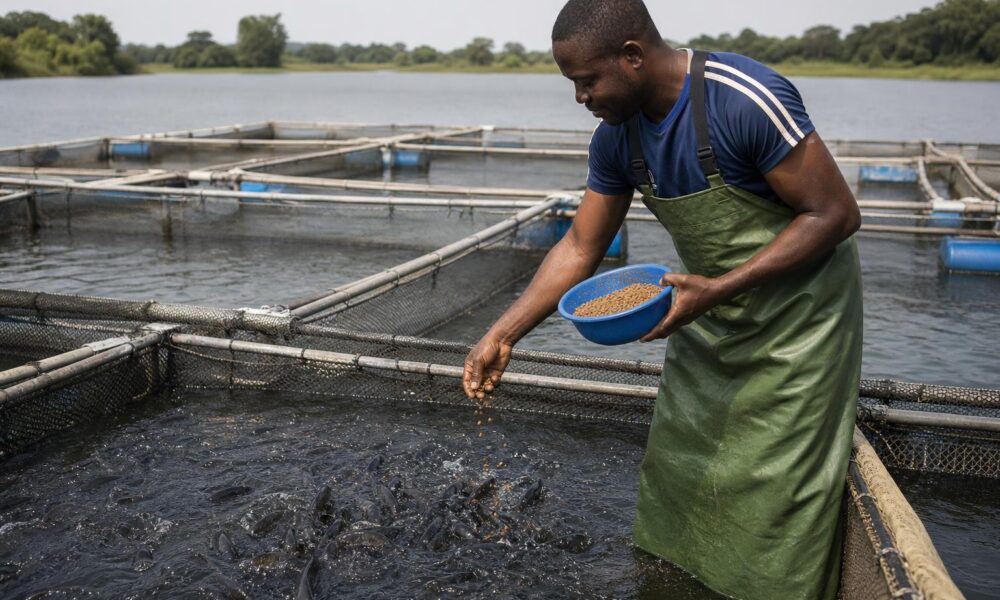
Land-based aquaculture is emerging in the Republic of Congo as fish farmers seek ways to respond to shortages, polluted waterways and rising prices.
Table Of Content
The approach uses tanks and ponds on land, allowing producers to raise fish in controlled environments rather than relying entirely on natural waterways. It is being presented as a possible way to improve the availability and accessibility of fish, although it has not resolved the country’s supply and affordability challenges.
Pressure on traditional fish sources
Pointe-Noire, the country’s economic capital, has more than a dozen rivers, including the Tchinouka. However, many of the city’s waterways are described as unusable because of pollution and other challenges.
The Republic of Congo is also facing shortages of both marine and freshwater fish, with overfishing identified as one contributing factor. Freshwater fish is increasingly absent from some people’s plates as supplies remain limited and prices rise.
For some households, fish is becoming a luxury. The minimum wage is 50,000 CFA francs, while a single giant catfish can cost more than 7,000 CFA francs. Against that backdrop, meat products are increasingly regarded as a basic necessity by some consumers.
Controlled production in urban areas
Fish farmer Wilde Bahamboula said tank-and-pond farming offers producers greater oversight and makes harvesting easier.
“We are operating right in the city, using tanks and ponds. This makes it easier to harvest the fish and monitor them,” Bahamboula said.
He contrasted the system with traditional production in natural ponds, where losses can be difficult to track. “Under the traditional system, you might put 1,000 fingerlings in a natural pond. Six months later, when you return to harvest them, you may find that only 100 or 200 fish remain,” he said.
The model allows farmers to operate closer to consumers while monitoring the fish more regularly. Its expansion, however, is constrained by the cost of inputs, particularly feed.
Feed costs remain a major obstacle
Feed accounts for around 75 percent of fish-farming production costs. Fish producers are therefore calling for closer links between aquaculture and the agricultural sector, along with greater local production of fish feed.
Reducing dependence on costly feed supplies could help producers manage prices and make farmed fish more accessible. Producers’ calls also point to the need for stronger connections between farming activities and aquaculture production.
The FAO is calling for innovation to help feed future generations. It estimates that Congo-Brazzaville produces nearly 1,500 tonnes of farmed fish annually.
A United Nations agency estimates that people in Congo consume an average of 25 kilograms of fish per person each year, underlining the importance of maintaining supply as natural sources come under pressure.
For now, aquaculture remains an emerging response rather than a complete solution. Its potential will depend on whether producers can expand output, control feed costs and make farmed fish affordable for households facing higher prices and limited supplies.







No Comment! Be the first one.