
ICJ to Deliver Judgment in The Gambia’s Rohingya Genocide Case Against Myanmar
The International Court of Justice is set to issue its judgment in The Gambia’s genocide case against Myanmar over allegations concerning the Rohingya.

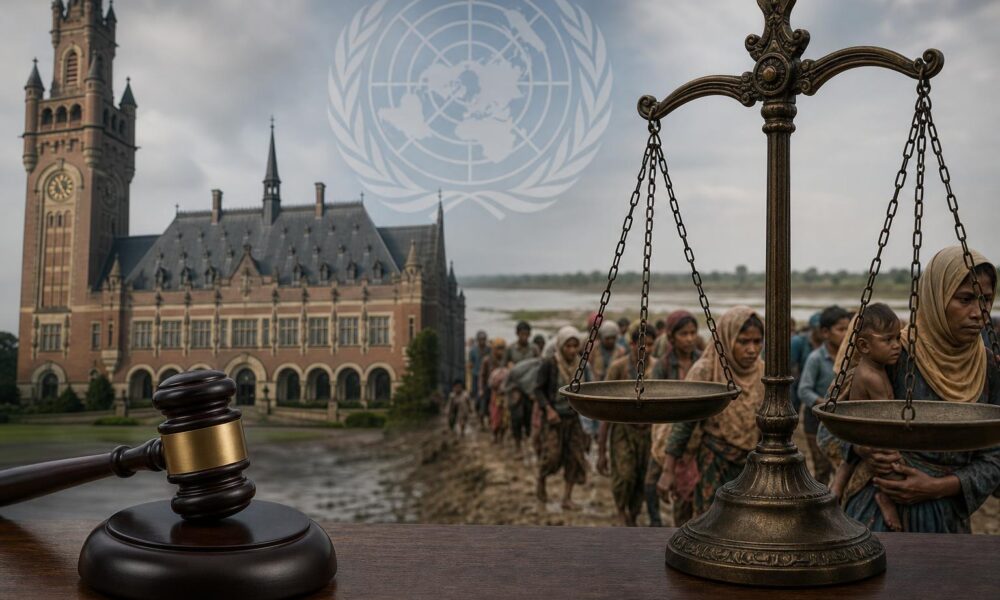
The International Court of Justice is scheduled to deliver its judgment in The Gambia’s genocide case against Myanmar, a legal dispute focused on allegations arising from the 2017 military offensive against the Rohingya.
Table Of Content
The court is due to begin reading the decision at 10am local time, or 09:00 GMT, at the Peace Palace in The Hague. The reading is expected to last up to 90 minutes.
The case, filed by The Gambia in November 2019 with backing from the Organisation of Islamic Cooperation, accuses Myanmar of bearing state responsibility for genocide against the Rohingya. The Gambia has asked the court to require Myanmar to prosecute those responsible, provide reparations and create conditions for the Rohingya to return safely.
Dispute over the 2017 offensive
The proceedings concern the military campaign that forced more than 730,000 Rohingya from Myanmar into Bangladesh. Survivors have described killings, mass rape and the destruction of villages.
A United Nations fact-finding mission concluded that the campaign included “genocidal acts”. The Genocide Convention, which is central to the case, requires proof of specific intent to destroy, in whole or in part, a national, ethnic, racial or religious group.
Myanmar rejects the genocide allegation. Its position is that its forces were responding lawfully to attacks by armed groups, and that there is no direct evidence showing an intention to destroy the Rohingya.
Myanmar has also challenged The Gambia’s right to seek reparations on behalf of the Rohingya.
Potential legal significance
The ICJ settles disputes between states and cannot prosecute individuals. The source identifies individual criminal trials as the responsibility of the International Criminal Court.
The judgment will be final and cannot be appealed. However, the court has limited enforcement powers. If Myanmar does not comply, The Gambia could ask the United Nations Security Council to consider action.
The decision could also mark the first time the ICJ rules that a state has committed genocide. In 2007, the court found that Serbia had failed to prevent the 1995 Srebrenica massacre, in which more than 8,000 Muslim men and boys were killed, but it did not find that Serbia itself had committed genocide.
Legal observers may also examine the ruling for precedents relevant to other proceedings, including South Africa’s case accusing Israel of genocide in Gaza. The precise implications will depend on the court’s findings and reasoning.
Rohingya awaiting resolution
The case comes as large numbers of Rohingya remain displaced. About 1.2 million are reported to be living in the Cox’s Bazar refugee settlement in Bangladesh, while roughly 550,000 remain in Myanmar.
Rohingya in Myanmar face restrictions on movement, healthcare and livelihoods, according to the background provided for the case. The ICJ’s ruling will address Myanmar’s legal responsibility as a state, rather than determine individual criminal liability.




No Comment! Be the first one.