
Bio Urges Africa-First Approach to Global Partnerships at Harvard
President Julius Maada Bio has called for African interests to guide international partnerships, urging governments to prioritize skills, jobs, local businesses, industrial development and...

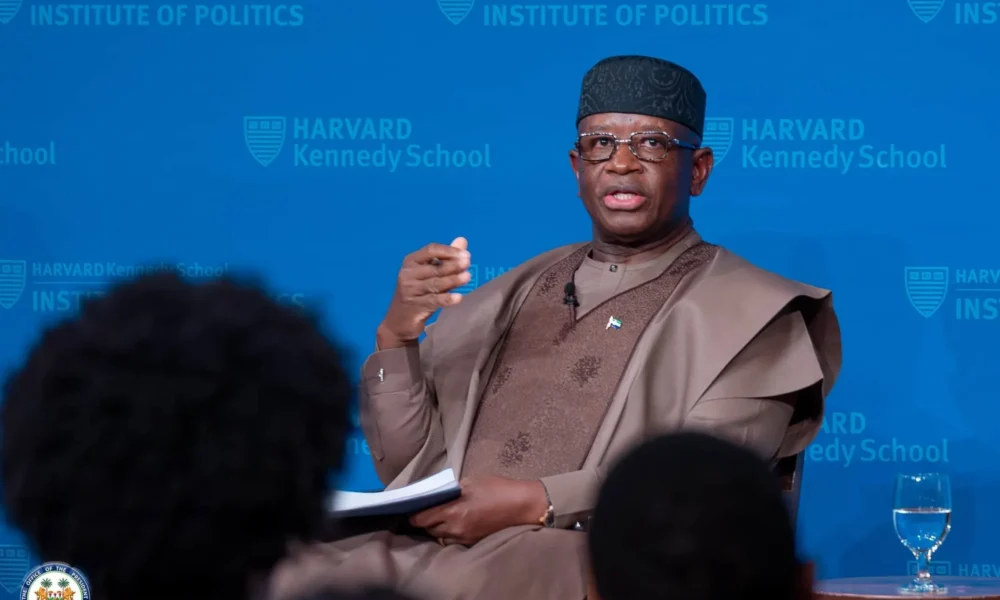
President Dr Julius Maada Bio has urged African governments to place the continent’s interests at the centre of relations with international partners, saying agreements should produce lasting benefits for African people and economies.
Table Of Content
Bio made the call during a keynote address at the John F. Kennedy Jr. Forum at Harvard Kennedy School on Tuesday, September 29, 2026. His remarks covered governance, democracy, education, artificial intelligence, regional cooperation, critical minerals and Africa’s relations with global powers.
He said governments should test proposed partnerships against four broad outcomes: whether they build skills, create jobs, strengthen local businesses and develop industries, while leaving African countries better able to make independent decisions.
Bio said Africa’s international importance was growing as major-power competition intensified, climate change affected livelihoods, artificial intelligence reshaped economies and public confidence in institutions faced pressure. However, he cautioned that the continent’s natural resources would not automatically produce prosperity, and that a youthful population alone could not guarantee economic opportunity.
Governance and human capital
The president said Africa’s future would depend largely on choices made by its leaders and citizens in governance, economic development and engagement with the wider world.
Reflecting on Sierra Leone’s political history, Bio recalled proceeding with the country’s 1996 elections despite the civil war and calls from some quarters to postpone the process. He said the elections did not end the conflict but established that Sierra Leoneans should have a voice in deciding who governs them.
He identified Human Capital Development, Free Quality School Education and the Gender Equality and Women’s Empowerment Act as measures undertaken by his administration. Bio said Africa’s demographic dividend would depend on sustained investment in education, practical skills and economies capable of creating opportunities.
On artificial intelligence, he said African youths should be prepared to develop and apply the technology to challenges within their societies rather than remain only consumers of systems created elsewhere.
Bio also said elections give governments the authority to serve, but public trust must continue to be earned after votes are counted. He called for accessible justice, accountable institutions and fair opportunities, while urging political leaders to protect institutions, encourage dialogue and avoid treating opponents as enemies.
Regional cooperation and partnerships
Bio said corruption, exclusion and unconstitutional changes of government had damaged African societies. He described the departures of Mali, Burkina Faso and Niger from the Economic Community of West African States as evidence of a serious loss of confidence within the regional bloc.
He said the door should remain open for the three countries to return to ECOWAS and called on the organisation to demonstrate its relevance. More broadly, he argued that African countries needed deeper cooperation because insecurity, climate shocks and trade challenges crossed national borders.
Bio said African governments should seek better terms when projects promised quick revenue but generated few local jobs. He also urged them to renegotiate technology agreements if African professionals were left unable to maintain the systems introduced through those arrangements.
On critical minerals, he said African communities should benefit through employment, knowledge transfer and wider economic prosperity. He also said restrictions on study and travel had narrowed exchange opportunities, including for Sierra Leoneans, while acknowledging the right of countries to set their own policies.
Bio rejected the idea that Africa should align exclusively with either the East or the West. “Africa will be pro-Africa,” he said.
Trade and global representation
The president cited the African Continental Free Trade Area as an opportunity to build a market serving more than one billion people. He said its full potential would depend on producers being able to move goods across borders without unnecessary delays.
He also called for stronger African representation in global institutions, including reform of the United Nations Security Council.
Addressing future policymakers, entrepreneurs, researchers and organisational leaders at Harvard, Bio encouraged them to take Africa seriously, engage African scholars and institutions, and examine who benefits from their projects.
He later held discussions with student leaders at Harvard University’s Center for African Studies on engaging African students at leading universities and empowering them to become future leaders in governance and the private sector. He thanked Zoe Marks, Oppenheimer Faculty Director, and Chidi Blyden, Executive Director of the Center for African Studies, for facilitating the engagement.
In concluding remarks, Bio said, “Africa’s future will be shaped by Africans,” adding that the success of the continent’s choices should be measured by their effect on the lives of its people.
He also said, God willing, he would hand over power again as a democrat in 2028.


No Comment! Be the first one.