

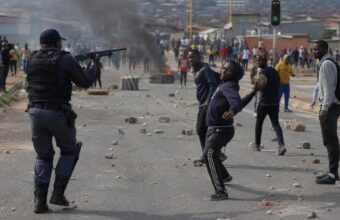
Anti-migrant protests in Johannesburg’s Soweto township and Durban turned violent on Thursday, as demonstrators demanded that refugee centres stop processing asylum applications.
Police said vehicles were set alight in both cities. Acting National Police Commissioner Lieutenant General Puleng Dimpane reported that 10 vehicles were torched in Johannesburg and 14 in Durban. Three people were arrested in Durban, he said.
Foreign-run businesses were forced to close during the unrest, while foreign-owned shops in Durban were reportedly looted, according to observations by Reuters and Agence France-Presse reporters. AFP reporters also said police used rubber bullets to disperse protesters in Durban.
Dispute over asylum ruling
The demonstrations followed a Constitutional Court decision in July that removed procedural barriers to asylum applications for some people who entered South Africa irregularly, did not have asylum transit visas or missed reporting deadlines.
Government spokesperson William Baloyi said the ruling had been widely misrepresented. He said it did not automatically give undocumented migrants refugee status, permanent residence or other legal rights.
“We are deeply concerned by what is going on now,” Baloyi said.
Baloyi also attributed the violence to deliberately false information being spread about the court’s decision. That explanation was presented as a government claim.
Pressure on asylum offices
South Africa’s Inter-Ministerial Committee on Migration held an urgent briefing on overcrowding at asylum offices after the ruling was implemented. The committee had said a day earlier that its offices were overwhelmed by incoming applications.
The protests form part of months of demonstrations by populist, anti-immigrant groups against undocumented foreign nationals. The unrest has led tens of thousands of people to flee, with some later repatriated by their governments.
Migrants are frequently accused of taking jobs, contributing to crime and putting pressure on public services, although the source material says those claims are not supported by evidence. The protests are unfolding in a country that remains deeply unequal, with about one-third of people out of work, according to the source material.





No Comment! Be the first one.