
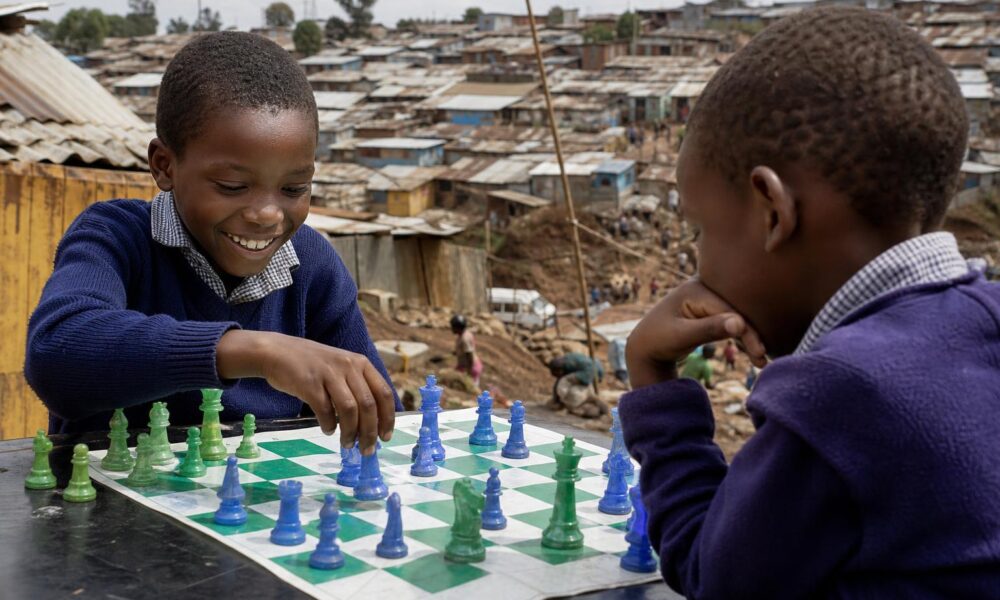
Children in Nairobi’s Kibera informal settlement are learning and practising chess with sets produced from recycled plastic waste.
Table Of Content
Kijiji Solutions has processed about 200 kilograms of plastic to make nearly 2,000 tournament-quality chess sets in partnership with The Gift of Chess. The initiative is intended to provide equipment to children who might otherwise be unable to afford it, while also putting discarded plastic to use.
From waste to chess pieces
Kijiji Solutions collects and sorts plastic and other waste in Kibera before sending selected materials elsewhere for processing. The plastic is then returned as pellets and used in an extruder fitted with moulds shaped like chess pieces.
Richard Haukom, founder of Kijiji Solutions, said the moulds were custom-made in Nairobi. “It comes back to us after washing, shredding, and other processes as pellets that we use in our process, which is an extruder with moulds that we had custom-made here in Nairobi that are in the shape of chess pieces,” he said.
Haukom said the quantity of plastic removed through the project should be viewed in perspective because chess pieces are small. “The total amount of plastic removed, it’s more symbolic than it is impactful in terms of the plastic waste problem,” he said.
He added that production could increase substantially if the organisation were able to meet demand for the sets.
Chess training at Centre of Hope School
Children at Centre of Hope School regularly play and practise chess using the locally made sets. The school regards chess as an important part of its curriculum, in an area where access to chess equipment and organised training is limited.
Chess teacher Ian Ombati said the game gives children an opportunity to compete on the basis of their ability rather than their circumstances. “Once they go to that board, it does not matter where you come from,” he said. “It’s just your skills and your competence.”
Esther Mutua, an 11-year-old student, has competed in tournaments and won certificates and medals. She said she initially attended training every day because she was not confident in her ability.
“When I started chess, I was not very good, so I always came for training every day. So after some months, I started improving in my academics,” Mutua said.
Another student, nine-year-old Markham Odhiambo, said chess helps him concentrate in class and answer mathematics questions.
Reported benefits remain largely anecdotal
Students and teachers at the school say chess has helped with concentration, problem-solving and classroom performance. Wilson Akhonya, the school’s head teacher, also linked chess participation to critical thinking, leadership and academic performance. Isabel Omondi, the school’s founder, said the game helps students become attentive, active, focused and concentrated.
Those claims are not supported by evidence in the available account. Studies have reported a modest positive correlation between chess and academic performance, but researchers have continued to debate whether chess itself causes those improvements.
For children in Kibera, the partnership between Kijiji Solutions and The Gift of Chess is nevertheless opening access to equipment and organised play while demonstrating a practical use for a portion of the settlement’s plastic waste.






No Comment! Be the first one.