
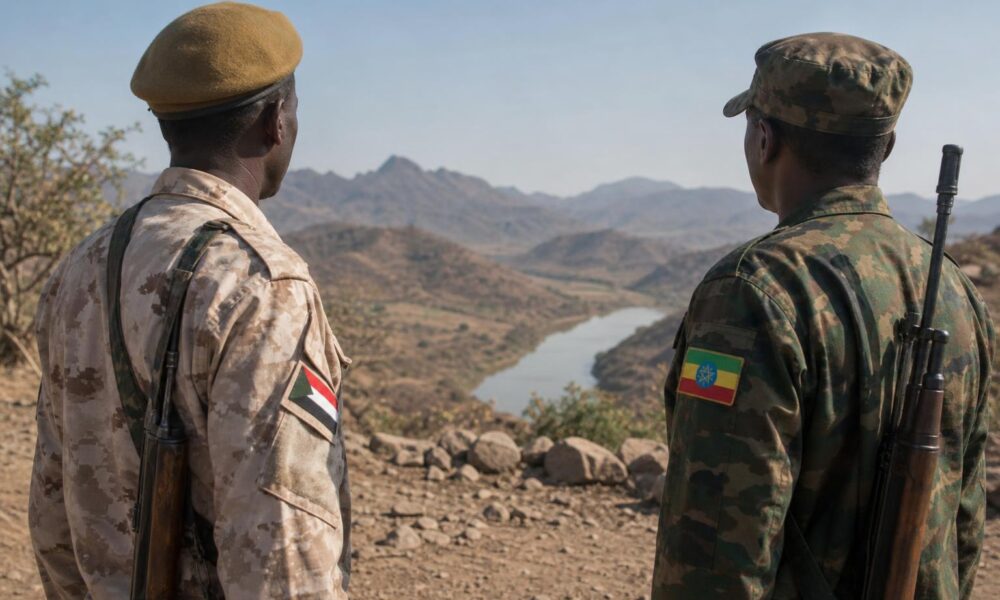
Sudan and Ethiopia have exchanged accusations over alleged support for armed groups operating across their shared border, deepening tensions between the neighbouring countries.
Sudan’s military accused Ethiopia of allowing Sudanese Rapid Support Forces (RSF) fighters to establish camps, launch drones and carry out attacks from Ethiopian territory. The military said it filed complaints with the United Nations Security Council and the African Union Peace and Security Council in early November, and submitted evidence.
Ethiopia rejected the allegation and accused Sudan’s military of supporting rebels fighting Ethiopian federal forces in the Tigray region. Sudan denied Ethiopia’s claim. The Associated Press said it could not independently verify either side’s accusations.
Evidence and border incidents
The Humanitarian Research Lab at Yale University reported an increase in military vehicles and equipment at an Ethiopian military base in Asosa, based on satellite imagery collected in late August. The research group said the buildup was linked to the RSF.
Nathaniel Raymond, who leads the lab, said the RSF was operating from Ethiopia in an effort to open another front in Sudan’s war. The group also warned that ignoring the tensions could lead to further escalation and mass displacement.
In a separate development, Ethiopia expelled six staff members of a Sudanese mission in Asosa and closed the consulate. Emergency Lawyers, a rights group, said a drone strike blamed on the RSF killed 41 people at a gathering of displaced people near Sudan’s border with Ethiopia in October.
Jervin Naidoo of Oxford Economics Africa said continued fighting in Tigray could divert Ethiopia’s attention from other issues and increase the risk of weapons and fighters moving across the Sudanese border. He said the situation “raises the risk that instability inside Ethiopia becomes another front in Sudan’s war — and vice versa.”
Regional alliances and disputes
Fighting returned to Tigray in September, following the 2020–2022 conflict between the Tigray People’s Liberation Front and Ethiopian federal troops and a 2022 peace agreement.
The border tensions are unfolding as Sudan’s war, which began in April 2023, enters its fourth year. The Armed Conflict Location & Event Data project estimates that 59,000 people have been killed, while about 13 million people have been displaced. Aid groups have warned that the actual death toll may be higher.
Alan Boswell, the International Crisis Group’s Horn of Africa project director, warned that “all the ingredients are present for an intensifying proxy war between Ethiopia and Sudan that further destabilises both countries.”
ACLED analyst Ladd Serwat said Ethiopia’s alleged support for the RSF was primarily logistical, while identifying the United Arab Emirates as the force’s main backer. The UAE has repeatedly denied involvement in Sudan’s war. Serwat also described Ethiopia as aligned with the UAE, Sudan as part of an Egypt-Eritrea regional grouping, and Turkey as having backed both Khartoum and Addis Ababa.
“Sudan and Ethiopia don’t operate in a vacuum; their relations amid these current domestic conflicts are shaped by external backers,” Serwat said.
Other longstanding disputes add to the strain. The Grand Ethiopian Renaissance Dam, built on the Blue Nile near the Sudanese border, cost about $5 billion and was completed in 2025. Egypt and Sudan have called for a legally binding agreement covering the dam’s filling and operation to protect their water resources.
The disputed Al-Fashaga region is another source of tension. Ethiopian farmers have long cultivated land there, while Sudanese troops moved into the area in late 2020 as Ethiopia was fighting Tigray rebels.



No Comment! Be the first one.